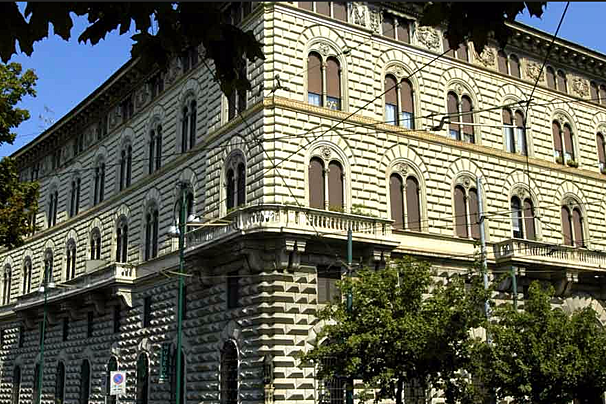
Galleria Pack, Southeast Milan
Opened in 2001, this beautiful gallery houses both Italian and international artwork, the well-established and the aspiring artist.
Discover and book the top Milan sights
Opened in 2001, this beautiful gallery houses both Italian and international artwork, the well-established and the aspiring artist.
Located at an old industrial facility, this multifunctional space is managed by Milan Town Council and open to all. It has a gallery exhibition space and offices of 200m2.
The Giuseppe Meazza stadium or San Siro (as it is better known) was conceived exclusively as a football venue. It was built to host the tempestuous and bi-annual games between the city's rival teams - AC Milano and Inter (F.C. Internazionale Milano).
Husband and wife Antonio and Marieda Boschi Di Stefano collected over two thousand works of contemporary art. About three hundred of these have been selected for their quality and distributed in chronological order in the ten exhibition areas of the Boschi Di Stefano Museum-Home.
This basilica, probably dating back to the end of the 4th and the beginning of the 5th century, was largely rebuilt in the 11th and 12th centuries and again in the 16th century. It also houses a chapel - Capella Sant'Aquilino - which still features mosaics dating back to the 5th century.
'Arengario' derives from the Latin arengarius which means 'gathering place'. Situated very close to the cathedral, its presence symbolised the continuous fight for power among the religious and civil forces of Monza.
This basilica was originally built by St Ambrose, in the 4th century, and contains the remains of the Apostles, John, Andrew and Thomas, as well as those of San Nazaro. Some remains of frescoes can still be seen despite many changes to its original structure over the years.
One of the most important religious buildings, dedicated to Milan's patron saint, Saint Ambrose, who founded this Roman Basilica. It is bright and well rebuilt and has a wonderful golden dome with thousands of mosaics. Saint Ambrose is buried here in the crypt.
The Ambrosian Library & Art Gallery, named after Ambrose the patron saint of Milan, opened in 1618 and is the city's oldest museum. The beautiful palace, as well as the world-class collections of paintings, manuscripts and books are well worth a visit.
Alessandro Mazoni, the famous literate and author of "I Promessi Sposi" or "The Betrothed", lived in this house from 1814 until 1873. It has been restored to show how it must have been when Manzoni died in 1873.
This Dominican convent, included in UNESCO's World Heritage Sites List, was built between 1463 and 1481 under the promotion of Duke Francesco Sforza. Leonardo Da Vinci's famous Last Supper fresco is located in its refectory.
The fortified castle of Borromeo sits on a rocky outcrop overlooking the town of Angera and is one of the best-preserved castles in the region. There are spectacular views of Lake Maggiore and across to the Alps, meaning it was an important strategic location.
This museum is one of the most significant house-museums in Europe and shows the taste of one of the finest collectors in the 19th century, the nobleman Gian Giacomo Poldi Pezzoli.
The Castello Sforzesco is Milan's main attraction after the Duomo. The castle's popularity is due in no small part to the dozen museums and archives within its grounds, with exhibitions on subjects as diverse as Palaeolithic history to 1950s furniture.
The Torre Branca (named after the liquor company that restored it in 2002) offers visitors a panoramic view point in the city. At 108.6 metres, the iron tower is the fourth highest structure in Milan, located in the city's most expansive park, Parco Sempione.
This 52-metre tower rises up in Bergamo's old town offering a strategic view across the town and the surrounding area. Apparently, it was originally 64 metres high but the top few metres were removed in the 19th century due to the risk of collapse.
This gallery is the oldest in Milan, originally founded in 1957, and initially focussed on post-war avant-garde.
Located in the very heart of the city, the Duomo is the third largest cathedral in the world and Milan's most famous cultural landmark. Commenced in 1386, the cathedral was initially built in terracotta stone then continued in the white Condoglian marble (shipped from Lake Maggiore) that gives the building its striking crystalline beauty.