Castle / Ruins Sights in Milan — 5 of Our Favourites

Discover and book the top Milan sights

Castello Sforzesco (Sforzesco Castle)

1. Castello Sforzesco (Sforzesco Castle), Northwest Milan

The Castello Sforzesco is Milan's main attraction after the Duomo. The castle's popularity is due in no small part to the dozen museums and archives within its grounds, with exhibitions on subjects as diverse as Palaeolithic history to 1950s furniture.

The castle was home to the noble Visconti family from 1368. It served as a fortress on the medieval wall with barracks and a moat. The castle was the Visconti's largest residence, with 180 metres in length, four fortified towers and a defensive wall.

The last Visconti dweller died with no heirs, and his legitimised bastard daughter was married to the military leader Francesco Sforza, an astute politician who became ruler of Milan in 1450. He built additions on the castle designed by Tuscan architect Filarete, who worked alongside military engineers.

His successor Galeazzo Maria Sforza completed the castle with a courtyard, frescoes in the rooms and a Ducal chapel. After his murder, his brother Ludovico il Moro took the power, transforming the Milanese court into one of the most refined of the time with artists such as Bramante or da Vinci. Frescoes painted by Leonardo in the Sala delle Asse still survive.

During the Spanish domination in the 1500s, an enormous star-shaped fortification was built around the castle. With up to 3,000 men protecting its walls, it was one of the biggest citadels in Europe. The star-shaped bulwarks were later knocked down under the Napoleonic reign. It was later restored in the late 19th century, when the Filarete tower was reimagined.

This long history of destruction and rebuilding has changed the image of the castle over the centuries, with the most recent work of restoration of the damage caused during World War II taken on by the acclaimed BBPR architectural partnership.

You can now admire the castle's defences on the outside, including remains of the ravelins, the 'ghirlanda' or outer wall with its defensive towers and a covered road underneath, as well as the moats. Inside, entering from Filarete Tower, the castle is dominated by the Courtyard of Arms, extensively restored in the 19th century, with the Spanish Hospital on one side. The Ducal Courtyard, on the other hand, was the centre of the dukes' residence and shows remains of the 15th-century building.

The Ducal apartments house the different museums of the castle, featuring Renaissance frescoes and other works of art and historical objects. Around the castle, there is an extensive park which has also been changed throughout the centuries.
Palazzo Marino Palace, Milan - Centre

2. Palazzo Marino Palace, Milan - Centre

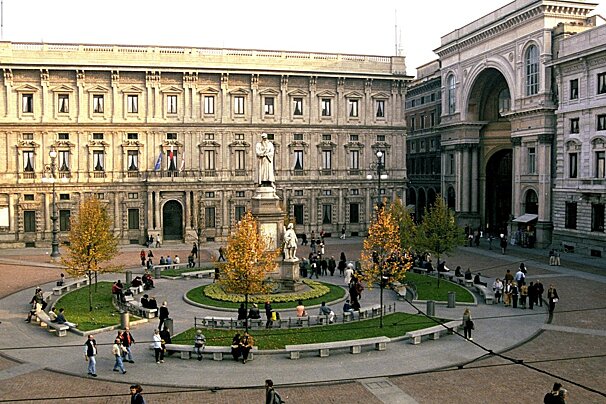
Palazzo Marino has been the home of Milan's town council since 1861. Located in La Scala square, the palace was designed by architect Galeazzo Alessi, from Perugia, in 1558.

Construction was interrupted in 1570, when Alessi left, and it was not finished until the end 19th century, under the direction of Luca Beltrami. Inside, there is a courtyard with Renaissance statues, and the rooms are decorated with frescoes and bas-reliefs.

The building is named after Tommaso Marino, a rich Genoan merchant who commissioned the palace to make it his private home, although he died in bankruptcy. This palace was met with the opposition of the Milanese people when it was being built, who deemed it too ostentatious.

It became public property in 1781, when it was restored. It was struck by the Napoleonic wars and the Second World War, but it has kept in pretty good shape and you can now visit some of its most impressive rooms.

Torre del Gombito Tower, Bergamo

3. Torre del Gombito Tower, Bergamo

This 52-metre tower rises up in Bergamo's old town offering a strategic view across the town and the surrounding area. Apparently, it was originally 64 metres high but the top few metres were removed in the 19th century due to the risk of collapse.

The name 'Gombito' derives from the location of the tower 'compitum' (crossing), on the intersection of the two main roads in any Roman settlement, the cardo and decumano (nowadays the Vian San Lorenzo and Via Gombito). Built in the 12th century, it still retains its medieval defensive style.

The tower had an important role in the fights between the guelfi and ghibellini in Bergamo during the 12th and 13th centuries, the former in favour of the Pope and owners of the tower, while the latter were on the emperor's side.

It still boasts a distinctive Romanesque style, although in the 16th century it was turned into a commercial establishment and two shops were added on each side. In 1877, it was bequeathed to the town of Bergamo and extensively renovated. From its terrace, you have a 360 degrees view of the city, its surrounding plains and hills and, on clear days, you can even see Milan and the Alps.

Palazzo Reale (Royal Palace), Milan - Centre

4. Palazzo Reale (Royal Palace), Milan - Centre

The Royal Palace is a classically beautiful example of 18th-century Milanese architecture. Built in the 1300s, it was initially the residence of the Visconti and Sforza families, then later home to the Spanish and Austrian governors.

Giuseppe Piermarini, the architect who designed La Scala, renovated the Palazzo Reale between 1771 and 1778 in Neoclassical style, giving it its grand appearance of today. From the end of the 1500s, the palace housed the first permanent theatre in Milan - though it was destroyed by fire in 1776.

In 1965, the city of Milan purchased the palace to use as offices, museums and temporary exhibitions. It is a mansion of utter opulence and host to an impressive array of world-class art shows. Popular and celebrated exhibits of the past include the works of Caravaggio, a Francis Bacon portrait show and a Vivienne Westwood retrospective.

Rocca Borromeo Castle, Angera

5. Rocca Borromeo Castle, Angera

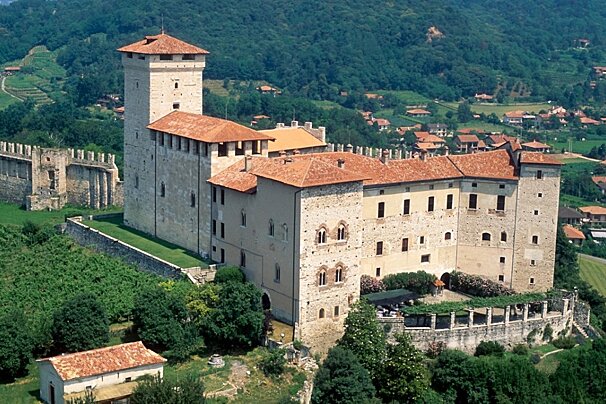
The fortified castle of Borromeo sits on a rocky outcrop overlooking the town of Angera and is one of the best-preserved castles in the region. There are spectacular views of Lake Maggiore and across to the Alps, meaning it was an important strategic location.

The original castle dates back to the 11th century and its five remaining buildings dating from subsequent periods to the 17th century are in excellent condition. It fell into the hands of the Borromeo family in the 15th century, who made it a key feature of their defensive system.

There are some stunning 13th-century frescoes in the Sala di Giustizia. They were made at the time when the Visconti the castle and they depict his success at the battle of Desio in 1227, as well as Zodiac signs.

The castle is also home to an extensive Dolls & Toys Museum, which showcases more than a thousand objects dating back from the 18th century to our days. You can also visit the medieval gardens, restored according to old codices and manuscripts.