Religious Sights in Milan — 9 of Our Favourites

Discover and book the top Milan sights

Duomo (Cathedral)

1. Duomo (Cathedral), Milan - Centre

Located in the very heart of the city, the Duomo is the third largest cathedral in the world and Milan's most famous cultural landmark. Commenced in 1386, the cathedral was initially built in terracotta stone then continued in the white Condoglian marble (shipped from Lake Maggiore) that gives the building its striking crystalline beauty.

As well as its religious significance, the cathedral can be appreciated for its array of architectural styles, the work of generations of Lombard builders and architects. Marvel at literally thousands of statues both inside and out.

From the roof terrace a grand view, stretching across the city as far as the Alps on a good day, can be glimpsed through hundreds of Gothic spires. There is a Duomo Museum charting the history of its construction, as well as an exhibition of the archaeological digs on site.

Duomo di Monza (Monza Cathedral), Monza

2. Duomo di Monza (Monza Cathedral), Monza

Founded in the 6th century, the cathedral of Monza, also known as basilica of Saint John the Baptist (San Giovanni Battista) is Monza's most important religious building.

In the end of the 6th century, queen Theodelinda, wife of Lombard king Autari and later of king Agilulfo, founded this church as a chapel for their nearby palace in the outskirts of the small village of Monza and close to river Lambro. Theodelinda was instrumental in the conversion of the Lombards to catholicism, so the church was founded relying on Pope Gregory the Great's support. Almost nothing survives from this initial phase of the Duomo, besides part of the precious liturgical treasure which can now be seen at the cathedral's museum.

The building was massively renovated at the end of the 13th and beginning of the 14th century under the patronage of the Visconti family. Legend says that Theodelinda and Saint Elizabeth miraculously appeared to father Francesco da Guissano showing him the location of some ancient relics. The new construction works begun in 1300, and the body of Theodelinda was moved in 1308 to its new location.

Around 1350 a new building phase started following the designs of Matteo da Campione, when the façade, baptistery and pulpit were erected. The Visconti wanted to turn the basilica into a great church where imperial coronations would take place because, according to the old German custom, the emperor had to receive three crowns made of different materials and in different places: silver in Aachen, gold in Rome and iron in Monza.

The apse was profoundly changed in the 16th century due to the needs of the Trento Counter-Reform, and a new tower was also built. The central nave's vault was renovated in the 17th century, and a new chapel for the treasury created. Lots of new Baroque paintings and altarpieces were also incorporated. The façade was later transformed in the 18th century.

The current cathedral is, thus, the result of a series of building phases throughout the centuries.

San Nazaro Maggiore Basilica, Milan - Centre

3. San Nazaro Maggiore Basilica, Milan - Centre

This basilica was originally built by St Ambrose, in the 4th century, and contains the remains of the Apostles, John, Andrew and Thomas, as well as those of San Nazaro. Some remains of frescoes can still be seen despite many changes to its original structure over the years.

This church was built by Saint Ambrose, bishop of Milan, in 382 on the road connecting Milan and Rome to guard the Apostles' relics. The central apse containing the relics of San Nazaro was erected in 395.

It was extensively reconstructed in the end of the 11th century, when a vault was added, as well as with successive building works from the 16th to the 19th centuries. The Trivulzio Chapel, which obstructs the Romanesque facade, was added in 1512 by Bramantino

Santa Maria della Passione

4. Santa Maria della Passione Church, Milan - Centre

This basilica, the second largest in size after the Duomo in Milan, is an important example of Renaissance architecture. It was part of a large monastery of Lateran Canons, and the adjacent buildings now house Milan's Conservatory.

It was originally designed by architect Giovanni Battagio in the 15th century using a Greek-cross design, but this was later modified with a Latin cross. The barrel vault was decorated with frescoes by Giuseppe Galbesio da Brescia in 1583, depicting the Evangelists, Saint Ambrose, Saint Augustine, angels and allegories of the virtues.

Inside, there are also paintings by important artists of the 16th and 17th centuries in Lombardy, such as Crespi, Procaccini and Bramantino. The chapter house was decorated in 1510-1511 by Bergognone.

Much later, the facade, in an ornate Baroque style, was added by Giuseppe Rusnati.

Basilica di Sant'Ambrogio (Basilica of St Ambrose), Northwest Milan

5. Basilica di Sant'Ambrogio (Basilica of St Ambrose), Northwest Milan

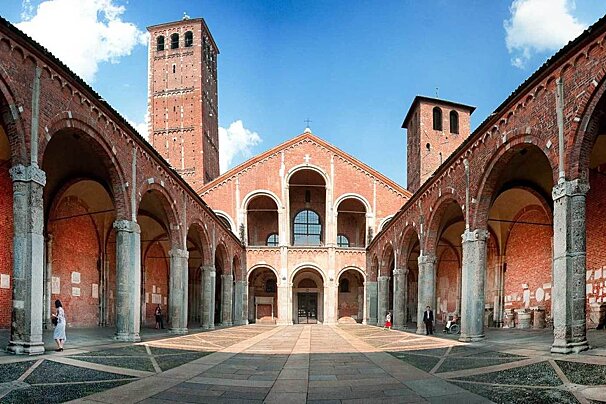
One of the most important religious buildings, dedicated to Milan's patron saint, Saint Ambrose, who founded this Roman Basilica. It is bright and well rebuilt and has a wonderful golden dome with thousands of mosaics. Saint Ambrose is buried here in the crypt.

Among the oldest churches in Milan, this basilica was built between 379 and 386, dedicated to the martyrs. It was erected in an area where many of them had been buried, victims of the Roman persecutions. Initially, it was outside of the city and in 789 a monastery of canons was established within the basilica grounds sharing the space with a group of monks, each of whom had their own cloister and bell tower.

It has undergone several restorations, and its current image owes more to the Romanesque style of the late 11th and early 12th century than to its Paleochristian origins. The building, rebuilt between 1080 and 1128 with a vault, is mostly composed of red brick with parts in stone and white plaster, with a large atrium in front.

Inside, the beautiful interior takes you back to the spirituality of the Middle Ages. There are medieval carved capitals, a marble ambo (pulpit) from the 12th century for Gospel readings as well as many other artworks.

Santa Maria in Strada Church, Monza

6. Santa Maria in Strada Church, Monza

Thus church takes its name from the road ('strada') that connected Monza and Milan. Formerly part of a Franciscan convent, the church was built in 1348 on the site of the monastery's old oratory.

Designed by Milanese architect Ambrosolius, the building was finished in 1357 in a Lombard Gothic style. A cloister was added later when the church became property of the Augustinian order. The choir, sacristy and bell tower were added in 1421.

The church was further changed in the 17th century when archbishop Carlo Borromeo promoted the construction of a new vault, and in the 18th century when the choir windows were transformed and the main altar decorated with marble and gilded bronze. It was also extensively restored in 1870.

At the cathedral museum of Monza you can see two frescoes from this church dating back to the second half of the 14th century as well as a sculpture of the Virgin from Santa Maria in Strada's façade.

Santa Maria delle Grazie Church, Northwest Milan

7. Santa Maria delle Grazie Church, Northwest Milan

This Dominican convent, included in UNESCO's World Heritage Sites List, was built between 1463 and 1481 under the promotion of Duke Francesco Sforza. Leonardo Da Vinci's famous Last Supper fresco is located in its refectory.

The initial design was created by Guiniforte Solari. However, Ludovico Moro, successor of Francesco Sforza, decided to make the church the resting place of the Sforza family. The apse and dome were enlarged and reworked in a classic Renaissance style by one of the best Italian architects of all times, Donato Bramante, although finished by Giovanni Antonio Amadeo.

During World War II, this Dominican monastery was almost completely destroyed by bombing. Three walls of the refectory that houses "Il Cenacolo" or "The Last Supper" were miraculously spared. This 15th-century mural painting that covers the back wall of the dining hall was commissioned by Da Vinci's patron, Duke Ludovico Sforza. Depicting in exquisite detail the dramatic moment when Jesus reveals that one of his disciples will betray him, it is considered Da Vinci's most accomplished work, indeed one of the finest paintings of the Renaissance.

Certosa di Garegnano Monastery, Northwest Milan

8. Certosa di Garegnano Monastery, Northwest Milan

This Carthusian monastery once stood at the centre of the village of Garegnano, nearly four miles beyond the city walls. It was founded in 1349 by bishop Giovanni Visconti to allow monks to live in silence and solitude.

Building works finished in 1352. The monastery received important visits, even writer Petrarca lodged inside. However, it had a complicated history due to continuous attacks.

In the 15th century, thieves ransacked the monastery and stole many artefacts. Finally in the 16th century, a band of robbers headed up by James Legorino, were defeated, and Legorino captured - he was executed, aged 30, close to the monastery, along with the Baptist Scorlino who had confessed to over 300 murders.

In the late 16th and early 17th century, the monks decided to completely renovate their monastery, constructing a new tomb. They also invested in frescoes and paintings - Simon Peterzano painted the walls around the altar with scenes depicting the life of Jesus, and produced three large paintings which currently sit behind the altar.

The monastery of Milan was abolished by Emperor Joseph II in 1782 and, as a result, fell into disrepair - the church was used to store gunpowder. The Certosa di Garegnano was subject to major restoration works during the 18th and 19th centuries.

San Lorenzo Maggiore

9. San Lorenzo Maggiore Basilica, Milan - Centre

This basilica, probably dating back to the end of the 4th and the beginning of the 5th century, was largely rebuilt in the 11th and 12th centuries and again in the 16th century. It also houses a chapel - Capella Sant'Aquilino - which still features mosaics dating back to the 5th century.

Originally, this important church was built outside the city walls, located on the Via Ticinensis which joined Pavia and Milan. Built with a centralised plant with four towers, and decorated with marble using reclaimed material from Roman buildings, it was probably promoted by emperor Theodosius.

The church was renovated in various phases during the Middle Ages, starting in the second half of the 10th century under Ottonian rule, when a new dome was erected. It suffered under fire in 1071, and had stability problems after an earthquake in 1175. In 1167, when the new city walls were raised, San Lorenzo became part of the central town of Milan.

Pillars were added in the 12th and 13th centuries to stabilise the dome, while the internal columns were replaced with octagonal supports, the southern tower enlarged and an external lantern constructed. The 15th century saw the erection of the Citaddini chapel.

The dome crumbled in 1573 and was reconstructed under the design of Martino Bassi, with works finishing in 1619. New chapels were added in a Baroque style, while the facade was rebuilt in 1894, designed by Cesare Nava with a large vestibule.

In front of the basilica, there is a group of Roman columns dating from the 3rd century AD. They probably belong to the old baths built by emperor Maximian and were located here when the construction of the basilica was finished.